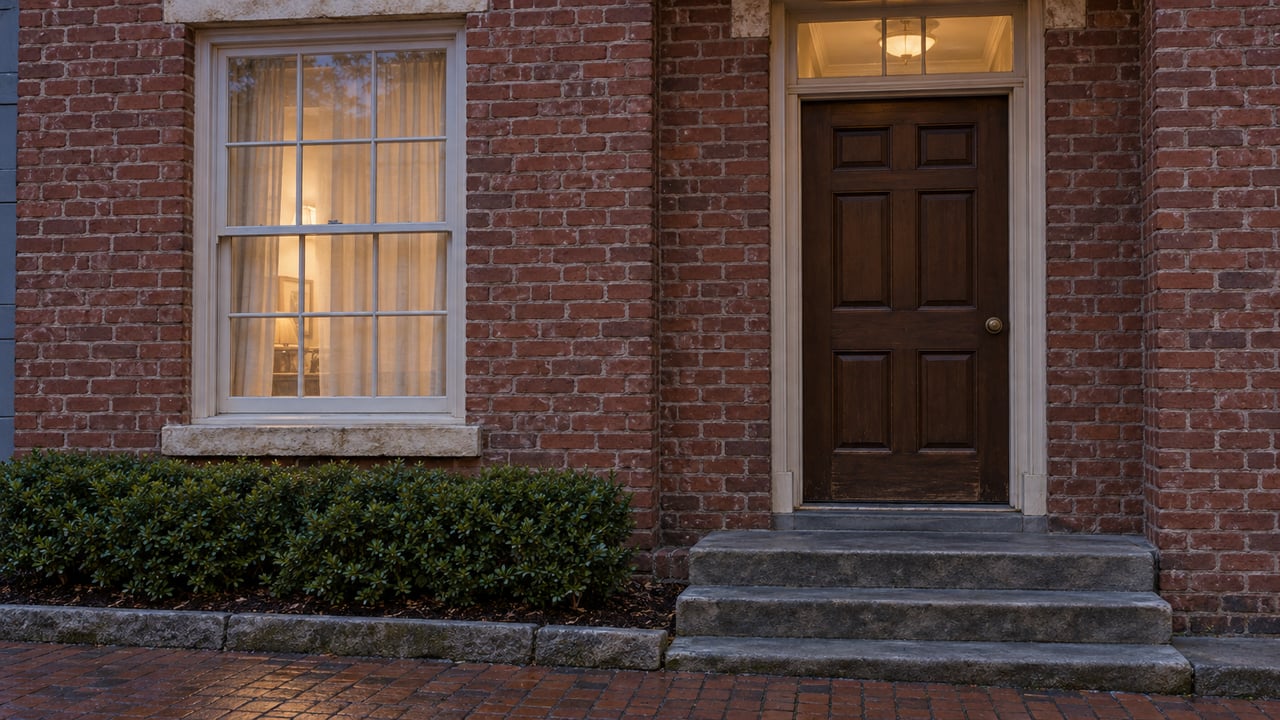
In 2021, a supply line in the President Woodrow Wilson House's heating system failed and did significant damage to the plaster in the Dining Room. The pipe was not a later replacement. Apart from the boiler, every radiator, valve, and supply and return pipe in the house at 2340 S Street NW is original to a building Waddy Butler Wood designed in 1915.
The house closed to the public on September 21 and is scheduled to stay closed through May 1, 2027, according to the Wilson House. There are no tours, public programs or private event rentals during that time. From the sidewalk it looks like a museum taking a long break. The planning documents show a heating and cooling retrofit for a landmark, designed so that a visitor next spring will have trouble finding any of it.
A Century on the Same Pipes
The house is about 14,200 square feet across four floors plus a basement, and it holds more than 8,000 artifacts, most from Wilson's presidency. Woodrow and Edith Wilson moved in in 1921. Edith lived there until 1961 and left it to the National Trust for Historic Preservation, which opened it to the public as a museum. The house has never had central cooling or mechanical ventilation. Its hydronic heat began failing noticeably in the mid-2010s.
The house's FY2025 annual report puts numbers on the problem. Frequent pipe breaks led preservation experts to recommend holding the house at a constant 55 degrees in winter. The museum closed from December 15, 2024, through April 1, 2025. The following winter it ran a limited Saturday tour schedule and asked visitors to dress warmly. Environmental monitors recorded readings that compare poorly with museum standards:
| Condition | Recorded inside the Wilson House | Accepted museum standard |
|---|---|---|
| Temperature | 48°F to over 90°F | 65°F to 75°F |
| Relative humidity | 38% to over 80% | 45% to 55% |
The low end of that temperature range sits 17 degrees below the standard and the high end sits at least 15 above it. The humidity swings run well past the target band in both directions. The Wilson House's project page says these swings stress the historic building and can speed the deterioration of wood, textiles, paper and paintings. For several years the house protected its collection by closing or limiting visits in cold weather. The current closure is meant to end that pattern.
The New System Sits Where the Old One Did
The National Trust published its bid documents for the job, titled Building Systems Improvements, along with notes from a July 15, 2026 pre-bid meeting. They lay out the plan in unusual detail. The boiler and its equipment come out of the basement. A new 400-amp main distribution panel replaces the old electrical panel, and a subpanel goes in on the fourth floor. Crews open selected sections of walls and ceilings to run refrigerant and electrical lines for a variable refrigerant flow system, known as VRF.
The pre-bid meeting summary describes the formal rooms this way.
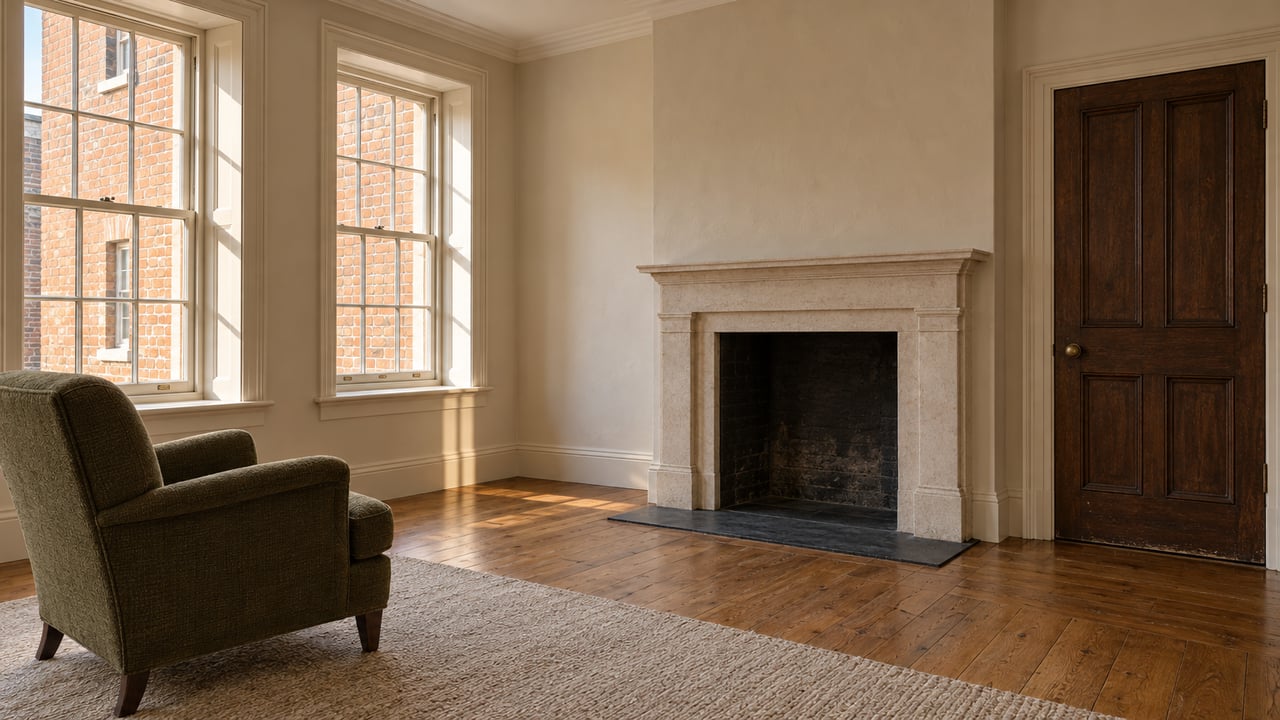
Most existing radiators in formal living areas are hidden within built-in enclosures behind decorative metal grilles. New FCUs will be installed in place of the original radiators behind the original grilles with new supply registers installed in the window sills where shown on the drawings.
The fan-coil units, or FCUs, go into the cavities the radiators used to fill, behind the original metalwork. In the formal rooms the visible change is limited to supply registers in the window sills. In a few spaces, including the Kitchen, the Exhibition Gallery, the Store Room and parts of the Ground Floor, the old radiators stay in place but are disconnected and capped. Heating and cooling there come from ceiling VRF units or ducted fan coils. Wherever crews open a wall or ceiling, the contractor repaints the entire surface after patching, so a repair doesn't leave a mismatched patch.
The engineering firm is Henry Adams, which says the National Trust selected it in 2022 as the historic-design specialist for the mechanical upgrade. The firm names two main design problems: routing refrigerant pipe through the house and hiding indoor units within historic fabric. Mark Stoner, the National Trust's Senior Director of Preservation Architecture, is the owner's representative.
The age of the house also limits where the walls can be opened. In 2021, during repairs to the riser pipes, crews found friable asbestos insulation wrapped around the supply line. The bid documents tell contractors to plan for abatement wherever walls are opened. They also say the intent is to avoid the old steam riser locations and keep the existing material encapsulated where reasonable. In practice, a 1915 house steers the new system toward the existing radiator enclosures and away from the old riser locations.
What Shows From S Street
Very little of this project reaches the facade. The documented exterior changes are a new energy recovery ventilator in the basement and two rooftop heat pump units, one on each roof. The ventilator takes in air from the east lightwell and exhausts it through a new louver in an existing lightwell on the front elevation. The shutoff valves for the rooftop units sit in small rooftop enclosures. An August 6 addendum added replacement of the two lower flat roofs to the contractor's scope, with new insulation, 60-mil TPO roofing, flashings and drains, plus a coating on the existing north-roof light monitor.
The house is a National Historic Landmark in a locally designated historic district, so the work needs approval from both the D.C. Historic Preservation Office and the Commission of Fine Arts. The National Trust says it will secure both approvals through its permitting process. The contractor is responsible for any temporary right-of-way permits, including temporary street blocking. Because the work runs through the winter, the contract also requires temporary heat inside the building for the length of the job.
The bid schedule put the start of construction at November 16 and substantial completion at March 19, 2027. The notes allowed that the finish could run past that date. If that schedule held, work inside the house would begin in mid-November, though the National Trust's updates page has not posted progress reports. Before any of that, museum staff are documenting, photographing, cataloging, conserving, packing and moving thousands of artifacts and archival materials out of the work areas. The project is still raising money. The FY2025 report said the house had secured $750,000 from the National Trust and needed to raise $2 million more. The project page still asks for support from individuals, foundations, companies and community partners.
This Winter's House Tours Are on Massachusetts Avenue
With S Street closed, the nearest historic house tours this season are at Anderson House, 2118 Massachusetts Avenue NW, between 21st and 22nd Streets. Arthur Little and Herbert Browne designed it, and the National Park Service dates its construction to 1902 through 1905. That makes it about a decade older than the Wilson House, and it is another mansion whose interiors have to be maintained as a museum. Visits are one-hour docent-led tours of the first and second floors, starting at a quarter past the hour. The last tour leaves at 3:15. Through December 31 the house is open Tuesday through Saturday from 10 a.m. to 4 p.m. and Sunday from noon to 4 p.m. Adult admission is $12, with a $9 rate for seniors and D.C. residents with ID. The first-floor changing gallery is showing Voices of Revolution through January 10, 2027. It includes more than forty rare documents, maps, paintings and artifacts.
Upcoming dates within walking distance:
- Thursday, November 5: The Phillips Collection hosts Deep Sea Disco from 5 to 8:30 p.m. The Embassy of Japan's Japan Information & Culture Center holds an in-person lecture at 6:30 p.m., "'Uncanny Valley' Is Not What You Think It Is."
- Tuesday, November 10: Patrick K. O'Donnell discusses Revolutionary Snipers at Anderson House, 6:30 to 7:30 p.m.
- Wednesday, November 11: Anderson House is closed for Veterans Day.
- Wednesday, November 18: Historian Robert Selig gives "Old World Meets New World: Franco-American Encounters, 1776-1783" at Anderson House, 6:30 to 7:30 p.m.
- Through Friday, December 11: The JICC gallery shows Impressions of Japan: A Dialogue with Local Printmakers on weekdays from 9 a.m. to 5 p.m.
- Friday, December 11: The Phillips holds a noon Living Room talk, Conservation Insights on Avery, Gottlieb & Rothko. It ties into Avery, Gottlieb & Rothko: By the Sea, on view through January 24, 2027.
Anderson House also closes on Thanksgiving, Christmas Eve, Christmas Day and New Year's Eve. The Phillips at 1600 21st Street NW closes on Thanksgiving, Christmas Eve and Christmas Day.
When the Wilson House reopens next spring, the radiator grilles in its formal rooms are designed to look the way they always have. The main changes inside will be steadier air and new registers in the window sills. If you own an older Kalorama house and are weighing how much modern equipment its original details can conceal, Theo Adamstein brings an architect's eye to that question and would be glad to walk through it with you. Let's Connect.