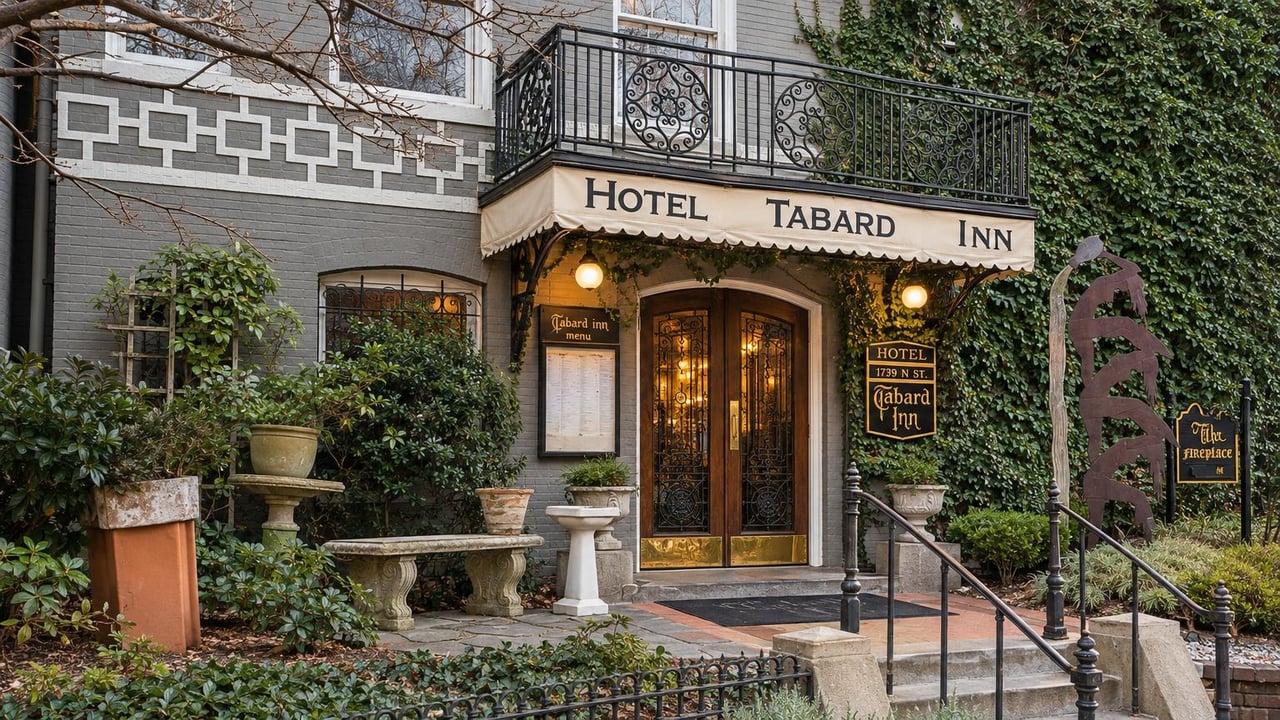
"Mrs. Henry Lloyd Aspinwall, who, with Mr. Aspinwall, is spending the winter at the Tabard Inn, at 1739 N street, entertained at luncheon there yesterday." The Evening Star ran that line on its society page on January 10, 1923. It comes from a Ghosts of DC history published this October that went back through the city's land records and old newspapers to rebuild the inn's early years.
The phrase "spending the winter" comes up again and again in that account. The Tabard opened as a place to live through the cold months a few blocks from Dupont Circle, and the society columns kept recording winter guests for decades afterward. That history explains why the inn's winter rooms are the best way to know it today: the fire in the Lounge, the jazz on Sunday and Monday evenings, and the holiday tables, starting with the one set today.
Three Rowhouses on the 1700 Block of N Street
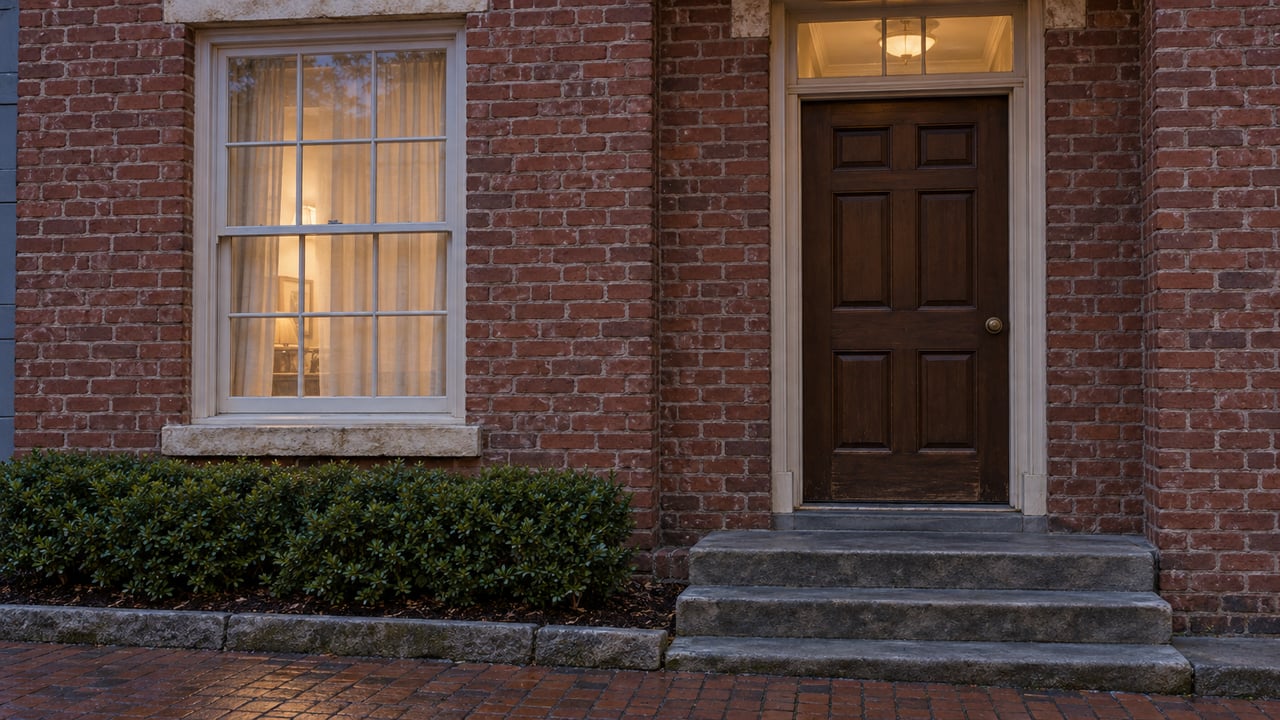
From the sidewalk the Tabard looks like a single address, but it occupies three rowhouses on the north side of the block, all built between 1887 and 1900. The oldest is 1737, built in 1887 for Caroline Sherman to designs by T. F. Schneider, the architect who later built the Cairo on Q Street. Number 1741 was built in 1888 for Mary A. Casey.
The middle house came last, and it is the heart of the inn. On April 25, 1900, Col. Frank L. Denny of the Marine Corps filed a plat that redrew the lot lines. That created lot 58, with 30 feet of frontage on N Street and just under 3,700 square feet in all. His architects, Hornblower & Marshall, designed a four-story brick house for the lot. The house then belonged to an admiral, a congressman and a senator in turn, and for a while people called it the Lippitt Mansion, after Sen. Henry F. Lippitt of Rhode Island.
Marie Willoughby Rogers bought 1739 by a deed dated September 25, 1922. She named the inn after the one in Chaucer's Canterbury Tales, and the National Register nomination says she spent hours at the Library of Congress looking for the right name. The inn still uses 1922 as its opening year and calls itself the longest continuously operating inn and restaurant in Washington.
The Ghosts of DC history also retires one legend. Edward Everett Hale is often said to have written "The Man Without a Country" in the Tabard's attic. Hale published the story in December 1863, 24 years before the oldest of the three houses was built.
A Winter Address Through a Sale and an Auction
The usual telling has Rogers opening the inn in the 1920s and running it until her death in 1970. The land records show a gap. In March 1927 she sold the inn to Alice Graham Dennis, who owed her $41,500 at 6 percent interest, payable at $425 a month. Under Dennis the winter guests kept coming. That October a society item noted that Miss Bertha Chinn "is now at the Tabard Inn, where she has spent the Winter for several years."
Dennis fell behind on the payments. At 3 p.m. on August 13, 1930, the two houses were auctioned in front of the buildings, and Rogers was the high bidder at $1,000 for 1739 and $1,000 for 1741. The price was low because older mortgages stayed with the houses, a $30,000 loan on 1739 and an $18,000 loan plus part of a second loan on 1741. For $2,000 and those debts she had her inn back, with the furnishings, and it now filled two houses instead of one.
The third house followed on May 23, 1935, when 1737 was deeded to Rogers's sister, Isla Willoughby, who owned it for the next 40 years. In a June 1933 Evening Star classified ad the inn promised a "tea room open to public" and a "pleasant garden," and both still describe the place. Winter guests appear again in the society columns. In November 1939, Col. Charles Annesley Romeyn and Mrs. Romeyn "will be at the Tabard Inn, 1739 N street, for the winter."
What the inn's "continuously operating" claim gets right is that the doors stayed open. Ghosts of DC found nothing in the records showing the Tabard closing through the sale, a lease to a second couple, or the auction.
The Winter the Navy Moved In
During World War II, Washington ran short of rooms, and the Navy needed housing for the women officers of the WAVES. Helen Clifford Gunter wrote in a 1992 memoir that she and a fellow officer were the first WAVES to live at the Tabard, in the spring of 1943. By May, she wrote, the inn housed 70 women officers, and by July they had their own mess and officers' club in the building.
Gunter also remembered Rogers driving a few of the officers on a charity tour of the embassies, where they chatted with Mrs. Woodrow Wilson. The Wilson house on S Street is itself in the middle of a winter project; we wrote about the radiator work keeping the Woodrow Wilson House closed until May. On April 15, 1944, the Evening Star's servicemen's listings included a "WAVE officers' spring dance, Tabard Inn, 9 o'clock tonight."
The Kitchen Is Newer Than the Rooms
After Rogers died, a developer planned to tear down the three houses for an office building, and neighbors on the block stopped it in court, according to the National Register nomination. Fritzi and Edward Cohen then bought the inn. They brought in Nora Pouillon and Margee Wright to run the dining room, which reopened in 1977, and Pouillon went on to open Restaurant Nora in 1979. The District added the Tabard to its Inventory of Historic Sites on February 27, 2020, and it joined the National Register that June.
The Tabard's own history adds the ownership arc. An employee stock ownership plan started in 1993, and the inn became majority employee-owned after Fritzi Cohen sold her shares back to the plan in February 2018. The inn now counts more than 75 service professionals across the hotel, restaurant and events.
The newest chapter is in the kitchen. Barcelona-born Pepe Moncayo, formerly of Cranes, has been the inn's culinary partner since the spring of 2023, according to the Tabard. In June, Washingtonian reported that he has been quietly reworking the Mid-Atlantic menu, which he described as previously "a bit all over the place." He told the magazine he had never heard of hush puppies, sorghum or chow-chow before taking on the Tabard. He also said there would be no Spanish detour: "you won't see a leg of jámon walking in the dining room." He pointed out that some staff have been at the Tabard for decades: "I'm not taking over anything, rather I'm joining with them." Rolando Gonzalez is chef de cuisine.
You can taste the effect on the fall menus. The dinner menu dated September 29 opens with $15 hush puppies with honey butter, cayenne and chives, beside Chesapeake Bay oysters at $23 a half dozen. The brunch menu dated September 30 lists the Tabard Donut at $2 each, shrimp and Anson Mills grits with smoked onion butter at $28, and chicken and waffle with sorghum, bacon and coffee jam at $25.
This Winter at 1739 N Street
The holiday season starts today. For Thanksgiving, November 26, the Tabard's OpenTable listing offers a buffet for parties of six or more at $98 per adult and $48 per child, and smaller groups can book à la carte in the main dining rooms. The posted Thanksgiving menu starts with celery root and Virginia apple soup with crispy country ham. Mains are herb-brined roast turkey, Atlantic salmon with cider beurre blanc, or stuffed winter squash, with a grilled NY strip for a $15 supplement. Pumpkin pie with bourbon whipped cream or a warm Virginia apple crumble comes after.
The Lounge is the room the 1923 guests would recognize most easily. The inn describes it as a place to "cozy up near the fire," and it has live jazz on Sundays and Mondays from 6 to 8:30 p.m. Washingtonian included the Tabard's fireplace in its January guide to getting through a D.C. winter. Weekday happy hour runs from 4:30 to 6 p.m., so on a Monday you can go from the bar straight to the start of the jazz.
On weekends, brunch runs from 10 a.m. to 3 p.m. Dinner is served from 5 to 10 p.m. Sunday through Thursday and until 10:30 p.m. on Friday and Saturday. On December 24 the inn has a $98-per-person Christmas Eve buffet for groups of 7 to 50, described in the listing as an all-you-can-eat holiday feast.
For more on how Dupont's established dining rooms are holding their ground, see our piece on the restaurants returning to Dupont Circle, and our Dupont Circle neighborhood guide covers the blocks around N Street.
The three rowhouses have run as one inn since 1935, joined inside behind facades built between 1887 and 1900. If you own one of these houses on these blocks, or are looking for one with this kind of architectural history, Theo Adamstein would be glad to walk through it with you. Let's Connect.